
What's cold is hot again! Here's how one facility answered all the questions and implemented trauma whole blood in 2018.
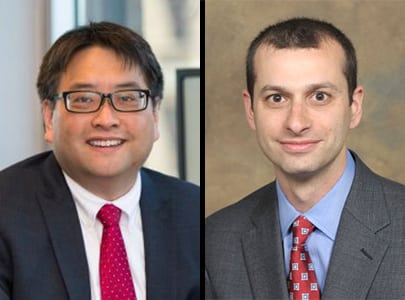
Drs. David Oh and Mike Goodman
About My Guests:
Dr. Mike Goodman trained in general surgery at the University of Cincinnati. After a fellowship in surgical critical care at the University of Texas Health Science Center at Houston, he returned back to the University of Cincinnati, where he now serves as an Associate Professor in general surgery, trauma and surgical critical care. This position has allowed Mike to continue basic and clinical research, focusing on the relationship of coagulation to post-traumatic inflammation, especially in the setting of traumatic brain injury. Clinically, he serves as the Chair of the Transfusion Safety Committee and focuses his clinical research on the appropriate resuscitation and care of the injured patient.
Dr. David Oh is the Chief Medical Officer of Hoxworth Blood Center, where he has worked since 2017 after 13 years in California, first at the San Diego Blood Bank, followed by the Stanford Blood Center. David trained in pathology at the Cleveland Clinic, and in Blood Banking/Transfusion Medicine at the BloodCenter of Wisconsin. David has served in numerous leadership roles in the California Blood Bank Society as well as Blood Centers of America and America’s Blood Centers.
DISCLAIMER: The opinions expressed on this episode are those of my guest and I alone, and do not reflect those of the organizations with which either of us is affiliated. Neither my guests nor I have any relevant financial disclosures.
Music Credit
Music for this episode includes "Cuando te invade el temor" and "Reflejo," both by Mar Virtual via the Free Music Archive. Click the image below for permissions and license details.




Joe:
In discussing the decision to use O positive (rather than O negative) blood, Dr. Oh walks us through the math regarding how few donors would be able to provide product with the added restriction of being Rh negative. Using male only donors obviously adds to this challenge.
Our blood supplier had previously used male only donors for FFP as part of TRALI mitigation strategy. More recently, however, they have allowed the use of FFP from nulliparous women or women who have tested negative for HLA antibodies.
I’m wonder if this was considered as a possible means of increasing supply of whole blood or any thoughts you might have regarding such an approach.
Thanks,
Bruce Jobe
Bruce, your comment is correct; using plasma rich products like whole blood from females who have never been pregnant or HLA antibody-negative female donors is acceptable, per AABB Standard 5.1.4.3 (31st edition). Individual centers have to decide whether or not to navigate the increased complexity of making sure that a female donor has been tested and/or answered “no” to the pregnancy question(s) before releasing a whole blood product. Sounds like your supplier decided “yes” on that, and Dr. Oh’s center went the other way. Either is fine. I don’t know the details of Dr. Oh and team’s considerations of that pathway, however.
-Joe
There are blood centers that provide whole blood from females who have never been pregnant or HLA antibody-negative female donors. Hoxworth Blood Center distributes some “high plasma content” components such as apheresis platelets from these donors, so this strategy was considered for whole blood.
We decided to use male-only donors for whole blood to simplify our process. Configuring our computer system to ensure that female whole blood could not be released without verifying that appropriate testing had been completed for anti-HLA antibodies would have increased complexity of our process. This would likely have delayed implementation. The transfusion committee also requested male-only as much of the literature has been based on male-only, and this may reduce variables for future publications based on our experiences.